From showroom to stockroom: Closing retail security gaps across the store

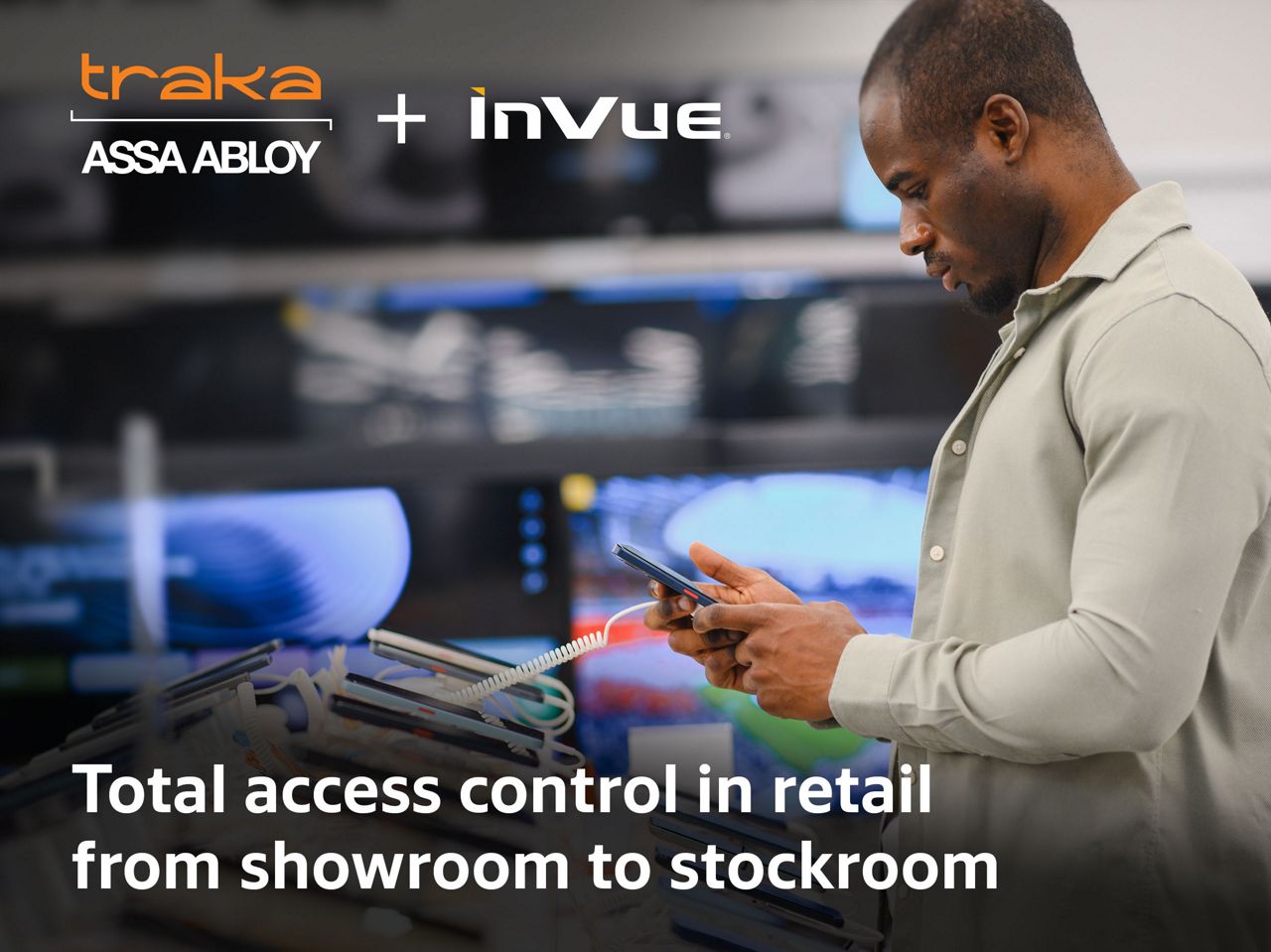
Retail loss prevention cannot stop at the sales floor. Discover how a Showroom to Stockroom approach helps retailers improve asset accountability, strengthen retail security, and close security gaps across the store.
Retail loss prevention has never had more tools. Locked display cases, security tags, cameras at every entrance and alarms on high-value merchandise. On the sales floor, most stores have layers of protection.
The back room a isdifferent story. It's where shipments arrive, inventory gets counted and handheld scanners change hands all day. In many stores, those devices live on an open charging cart.
That gap is why two ASSA ABLOY companies teamed up. InVue protects merchandise on the sales floor. Traka manages the handheld scanners and shared devices in the back room. Each knows its side of the store. Together, they cover all of it. That collaboration is Showroom to Stockroom..
How retail loss prevention has evolved
Over the past decade, organized retail crime and smash-and-grab theft pushed retailers to invest heavily in the sales floor. Locked cases, connected displays and smarter key systems now protect the products most likely to walk out the front door.
That investment made sense. External theft is visible, it's costly and it makes headlines.
Internal loss is quieter, and it's slower to surface. The median occupational fraud scheme runs 12 months before it's discovered, according to the ACFE's 2026 Report to the Nations. Schemes caught within six months carried a median loss of about $40,000. Schemes that ran five years or more topped $1.1 million.
The longer a gap goes unnoticed, the more it costs. That's why today's loss prevention teams need a whole-store approach, one that covers the stockroom as carefully as the showroom. What sales-floor security does well
Front-of-store protection has earned its place. Done well, it delivers:
• Deterrence: Visible locks and secured displays signal that merchandise is protected before anyone tries.
• Protection for high-value products: Electronics, fragrance, tools and other targets stay secured until an associate opens the case.
• A smoother sale: The right system lets associates unlock displays quickly, so customers aren't left waiting.
• Accountability at the display: When each associate carries their own key, every unlock ties to a person.
• A record of the floor: Cameras capture what happens in public areas of the store.
Where the back room gets left behind
The stockroom has different risks, and most sales-floor tools weren't built for them:
• Shared devices with no clear owner: Handheld scanners often sit on open charging carts, available to whoever walks past.
• Logins aren't custody: Most handhelds require a login, so every transaction carries a user ID. But a login doesn't show who picked up the device, who it passed to mid-shift or who had it after hours.
• Investigations built on reconstruction: When no one can say who had a device, LP pieces events together from schedules, camera footage and memory.
• Internal and external loss blur together: It's harder to tell whether an item left through the front door or the back room.
• Time lost every shift: Associates hunt for working scanners before they can pick, count or verify orders.
• Peak-season pressure: Retailers plan to add about 450,000 seasonal workers this quarter, according to Challenger, Gray & Christmas. More people share the same devices across more shifts.
Securing the showroom with InVue
InVue protects high-value merchandise on the sales floor without slowing down the sale. At the center is InVue's OneKEY ecosystem, a unified access system that allows associates to securely unlock merchandise using an electronic OneKEY or mobile credential.
Each credential is assigned to an individual, giving retailers control over who can access merchandise and visibility into who unlocked what, and when. If a credential is lost or deactivated, access can be revoked without rekeying locks across the store.
Customers can see and try products. Associates can unlock merchandise in seconds. And loss prevention teams gain greater control and accountability across the sales floor.
Securing the stockroom with Traka
Traka brings the same accountability to the back room. Traka asset lockers release handheld scanners and other shared devices only to authorized associates, using a card, PIN or biometric scan.
TrakaWEB records every checkout and every return. Each associate starts the shift with a fully charged device assigned to them. When a scanner doesn't come back, LP starts with a name and a timestamp, not a search.
The trade-off is small. Checkout from a locker can take about 10 seconds longer than pulling a device off a charger, according to Brian Davidson, Traka's Director of Business Development for Retail and Distribution. In return, every device has an owner at every point in the shift.
One shift, from stockroom to showroom
Before opening, an associate signs in at a Traka asset locker with a card, PIN or biometric scan. The locker releases a fully charged handheld assigned to them, and TrakaWEB records who took it and when. No hunting through a charging cart. No dead batteries.
The handoff. The associate scans in a shipment of high-value merchandise. Every scan ties to a device, and every device ties to a person. The product heads to the floor.
On the floor. The associate secures merchandise using InVue's retail security solutions, from package protection to locked cabinets and displays. Through the OneKEY ecosystem, associates use an electronic key or mobile credential to access merchandise, with every unlock tied to an individual. Customers can explore and try products, while associates keep the sale moving.
After hours, displays stay secured. Scanners go back in the locker to charge, and every return is logged. If one doesn't come back, LP starts with a name and a timestamp, not a search.
A whole-store approach to loss prevention
Run that shift every day, in every store, and the records add up. Device audits take minutes, not weeks. When inventory doesn't match, LP starts from a record: the device, the associate and the time.
Accountability also changes behavior. When every associate knows each device and each display is tied to their name, the shortcuts get harder to take. The strongest control isn't the one that catches a loss. It's the one that makes the loss less likely to happen.
InVue and Traka are separate systems; each built for its side of the store. Together, they give retailers one standard of protection from the display case to the back room.
Showroom to Stockroom. Secured.
Frequently asked questions
What is asset accountability in retail?
Asset accountability means knowing who had a shared device, key or piece of equipment at any point in a shift. It differs from transaction accountability, which only records who was logged in when a transaction happened.
How do retailers track handheld scanners?
Many retailers rely on app logins, which record who used the scanning software but not who physically held the device. Asset lockers add that missing layer. Each scanner is released to one associate and logged again when it's returned.
How long does employee fraud go undetected?
The median occupational fraud scheme runs 12 months before it's discovered, according to the ACFE's 2026 Report to the Nations. Schemes caught within six months carried a median loss of about $40,000, compared with more than $1.1 million for schemes that ran five years or more.
How do asset lockers help loss prevention teams?
Traka asset lockers release shared devices, such as handheld scanners, only to authorized associates using a card, PIN or biometric scan. TrakaWEB logs every checkout and return, so LP teams can see who had each device and when.
What is Showroom to Stockroom?
Showroom to Stockroom is a collaboration between InVue and Traka that helps retailers’ close security and accountability gaps across the store. Together, the two solutions support loss prevention efforts from the display case to the stockroom, creating a more complete approach to protecting merchandise, devices and operations.
Sources
• ACFE, Occupational Fraud 2026: A Report to the Nations: 12-month median duration
• Brady Ware, summary of ACFE 2026 findings: $40,000 and $1.1 million median losses
• Retail Dive, "Holiday hiring is getting 'smaller and more surgical'": 450,000 seasonal hires (Challenger, Gray & Christmas)
Secure Assets from Showroom to Stockroom
- Retail
- Traka Americas
Protect your store from showroom to stockroom.
Two companies. Two side of the store. One whole-store approach.